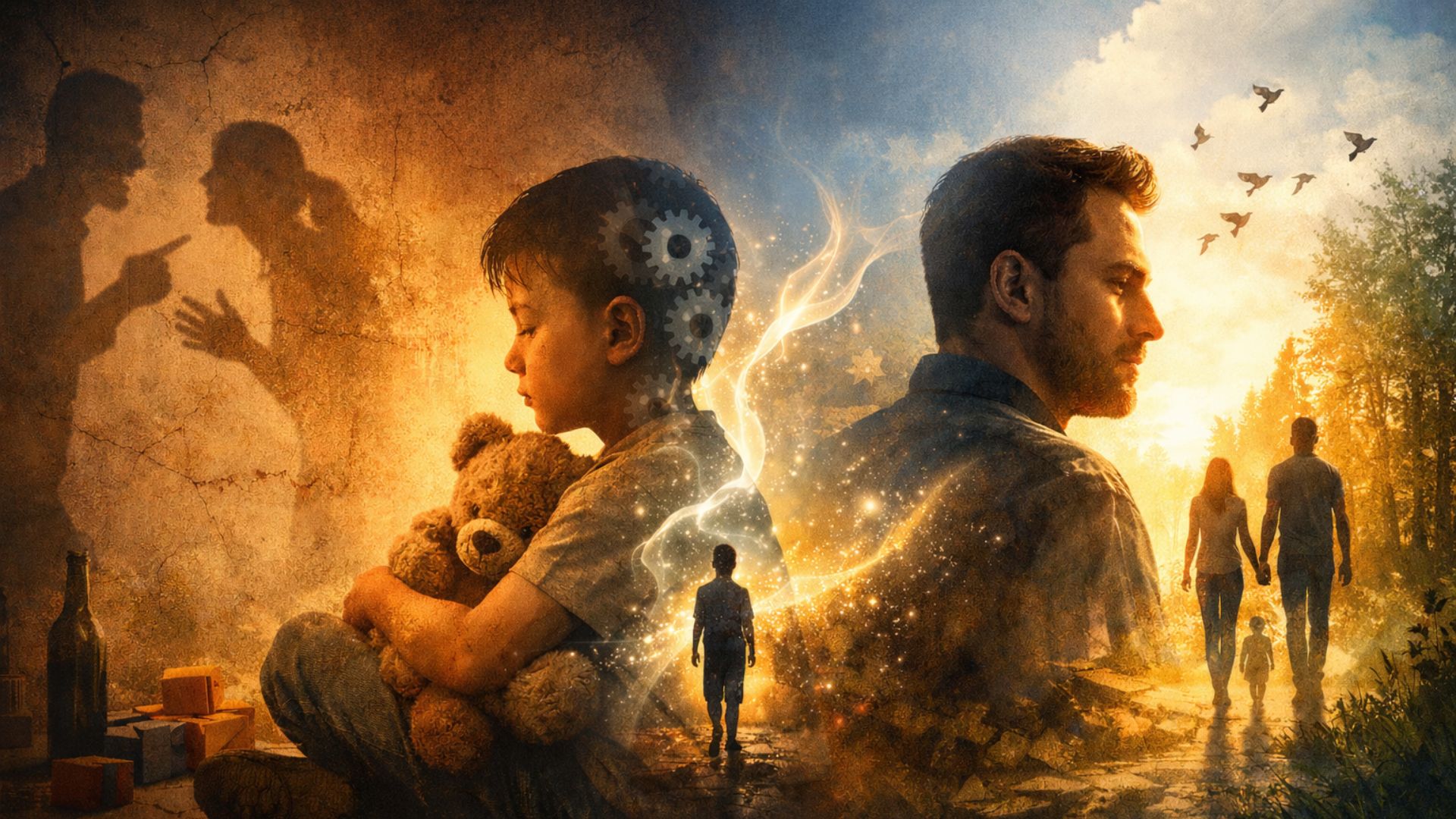
There is a quiet force moving through every human life. You can’t see it, you can’t measure it, and yet it shapes how we love, how we argue, how we work, how we fail, and how we dream. Most of us don’t notice it at all. We simply call it “who I am.”
But it has a history.
Long before we made conscious choices, long before we developed a philosophy or learned how to explain ourselves, we were already absorbing the world. Childhood is not a neutral waiting room before real life begins. It is the place where our emotional patterns, nervous system, and sense of safety are formed.
Childhood is not preparation, it is programming
Psychology has been clear about this for decades. The most formative years of human life happen early, roughly from birth to around seven years of age, with strong influences continuing into early adolescence. During this time, the brain is highly plastic. It learns fast, but it doesn’t judge. It records.
And what it records is not just what we are told, but what we live inside.
We don’t learn how relationships work from explanations. We learn by watching. We learn how love feels by observing our parents loving, struggling, disconnecting, or enduring. We learn how conflict works by seeing how anger is expressed, avoided, or punished. We learn our value through attention, tone of voice, presence, absence, and silence.
Children are not analysts. They are mirrors.
We don’t copy our parents, we absorb them
If a parent is anxious, the child learns that the world is unsafe.
If a parent is emotionally distant, the child learns that closeness is dangerous.
If love is conditional, the child learns to perform.
If anger is explosive, the child learns to hide or to explode later, when it feels safer.
This is not about blaming parents. Most people pass on what they themselves received. Trauma is rarely invented from scratch. It is inherited, adapted, softened in some places, intensified in others.
This is why, when you look closely at adult lives, you often see entire family stories playing out again. The inability to trust. The need for approval. The fear of abandonment. The habit of self-sabotage just when things start going well. These patterns almost never come from nowhere.

When chaos feels like home
This is where the invisible force becomes easiest to see.
A child who grows up with an alcoholic parent lives in a world of unpredictability. Love may be present, but it is unstable. Moods change without warning. Promises are broken. Safety is conditional. The child learns to scan the environment constantly, to adapt, to soothe, to disappear, or to overperform.
Years later, that same person may say, honestly, “I don’t understand why I drink the way I do.” And yet their nervous system recognizes alcohol not just as a substance, but as something familiar. It belongs to the emotional climate they grew up in. The body remembers what the mind tries to forget.
Or consider a child raised in a household where conflict was constant. Raised voices. Emotional volatility. No real resolution, just cycles of tension and release. For that child, chaos becomes normal. Calm does not feel safe. Calm feels suspicious.
As an adult, that person may unconsciously recreate the same atmosphere. Picking fights. Escalating small disagreements. Feeling restless when things are peaceful. Not because they want conflict, but because their system associates intensity with connection. Silence feels like abandonment. Drama feels like home.
There is also the child who learned early that love must be earned. Praise came only with achievement. Affection followed performance. Mistakes were costly. As an adult, this person may never stop striving. Never resting. Never feeling enough. Even joy becomes conditional.
From the outside, these patterns look irrational. From the inside, they feel inevitable.
Because what feels normal is often stronger than what feels healthy.
The science behind the invisible force
This idea is not poetic speculation. It is one of the most consistently observed findings in psychology, psychiatry, and public health.
Attachment theory, developed by John Bowlby, explains how early relationships with caregivers shape our internal blueprint for relationships later in life. Secure attachment tends to produce adults who can regulate emotions, trust others, and recover from conflict. Insecure attachment often leads to anxiety, avoidance, or emotional instability.
Not because someone is broken.
But because their nervous system learned to survive under different conditions.
One of the most influential bodies of research supporting this comes from the Adverse Childhood Experiences Study. This long-running study examined how early exposure to factors such as parental alcoholism, domestic violence, emotional neglect, or chronic household conflict affected adult health and behavior.
The findings were clear and uncomfortable.
Children who grew up with a parent struggling with alcohol abuse were significantly more likely to develop substance abuse issues themselves later in life, along with higher rates of depression, anxiety, and difficulty regulating emotions. The risk increased with each additional source of childhood instability.
Crucially, this was not about weak willpower or bad choices. Chronic stress in childhood reshapes how the brain processes threat, reward, and relief. Substances often become tools for emotional regulation long before they become habits.
Chaos leaves fingerprints on the brain.
Neuroscience research shows that growing up in a constantly stressful environment keeps a child’s stress response system permanently activated. This adaptation is useful in a dangerous environment, but costly in a stable one. As adults, these individuals often feel uncomfortable in calm situations, restless when life is peaceful, or drawn toward emotionally intense relationships.
The nervous system prefers the familiar even when the familiar hurts.

How to break the chain. Recognition comes before change
The invisible force is not destiny. It is conditioning.
And conditioning can be observed.
The first step toward freedom is not fixing yourself. It is not healing, optimizing, or reinventing your identity. The first step is noticing. Seeing your patterns without judgment. Recognizing that reactions you thought were “just you” might be echoes of a much earlier environment.
This realization can be uncomfortable. It challenges the idea that we are purely self-made. It asks us to see our parents not only as individuals, but as transmitters of love, fear, resilience, and unresolved pain.
Acknowledgment is the doorway.
You cannot change what you refuse to see.

From inheritance to choice
Overcoming the invisible force does not mean erasing your childhood or rejecting your parents. It means integrating what shaped you and choosing, consciously, what you carry forward.
Research consistently shows that people who become aware of these inherited patterns often through reflection, therapy, writing, meditation or honest conversation are far less likely to repeat them unconsciously. Awareness alone reduces the power of old scripts.
The hopeful truth is this: the same brain that absorbed these patterns early in life remains capable of change. Slower now, yes. But wiser.
You are not only who you were as a child.
But you cannot step out of old patterns until you understand where they came from. When the invisible force becomes visible, it loses its power to quietly run your life.
And that is where real freedom begins.